
Is Flying Safer Than Driving?

Many people feel uneasy about flying, even though they rarely think twice about getting behind the wheel of a car. This contrast often comes down to perception rather than reality. While plane crashes receive intense media attention, car accidents happen far more frequently and are often the subject of personal injury claims.
So, is flying actually safer than driving? When you look at the data and how safety is measured, the answer becomes much clearer.
How Is Safety Measured?
To compare flying and driving fairly, safety must be evaluated using consistent metrics. Experts typically rely on a few key measurements:
- Fatalities per mile traveled: How many deaths occur for the total distance traveled
- Fatalities per trip: The likelihood of death during a single journey
- Fatalities per hour traveled: Risk based on time spent in transit
Each metric tells a slightly different story. For example, flying often covers long distances quickly, which can make it appear even safer when measured per mile. Meanwhile, driving involves more frequent, shorter trips, increasing overall exposure to risk.
Air Travel Statistics
Globally, there are tens of millions of commercial flights annually, yet fatal accidents are extremely rare. In the United States, major commercial airlines have gone multiple years without a single fatal crash. That level of consistency reflects how tightly regulated and systematized the aviation industry has become.
When safety is measured per distance traveled, the gap becomes even clearer. Air travel results in far fewer than 1 death per 100 million passenger miles, making it one of the safest ways to travel long distances.
Car Accident Statistics
Driving tells a very different story. Car accidents are not rare events—they are a daily occurrence, and the numbers reflect that. In the United States alone, more than 40,000 people die each year in motor vehicle crashes, according to federal safety data. Beyond fatalities, millions more are injured annually in collisions ranging from minor to severe.
When looking at distance-based risk, driving results in about 1.3 deaths per 100 million vehicle miles traveled. That rate is dramatically higher than what is seen in commercial aviation.
Key Factors That Make Flying Safer
Air travel isn’t just safer by chance—it’s the result of a highly controlled system designed to reduce risk at every level. From the people operating the aircraft to the technology and oversight behind each flight, multiple layers of protection work together to prevent accidents.
Some of the most important safety advantages include:
- Highly trained pilots: Pilots must complete rigorous training, log extensive flight hours, and undergo ongoing evaluations throughout their careers
- Strict safety regulations: Aviation is heavily regulated, with detailed rules governing everything from maintenance to pilot scheduling
- Standardized procedures: Every phase of a flight follows set protocols and checklists, reducing the chance of human error
- Advanced aircraft technology: Modern planes include automated systems, collision avoidance tools, and multiple backups for critical functions
- Routine inspections and maintenance: Aircraft are inspected frequently and must meet strict safety standards before every flight
- Air traffic control oversight: Flights are continuously monitored and guided, helping prevent collisions and manage airspace safely
Because these safeguards are built into every flight, risks are identified and managed long before they have a chance to become serious problems.
Why Driving Feels Safer (But Often Isn’t)
Even though driving carries a higher level of risk, many people feel more comfortable on the road than in the air. This isn’t based on statistics—it’s largely influenced by how people perceive control, familiarity, and danger in everyday situations.
Several psychological factors help explain this disconnect:
- A sense of control: Being behind the wheel makes people feel like they can prevent accidents, even when many risks are outside their control
- Familiarity with driving: Most people drive regularly, which makes the activity feel routine and less threatening
- Less dramatic exposure to accidents: Car crashes happen frequently but rarely receive the same level of media attention as plane crashes
- Normalization of risk: Because accidents are so common, they are often viewed as an unavoidable part of daily life
- Fear of the unfamiliar: Flying involves unfamiliar environments and sensations that can heighten anxiety
As a result, people often underestimate the everyday risks of driving while overestimating the rare dangers associated with flying.
Contact The Law Firm of Alton C. Todd Personal Injury Lawyers to Schedule a Free Consultation With a Galveston Personal Injury Lawyer Today
When comparing the two, the data consistently shows that flying is significantly safer than driving. Commercial aviation operates within a highly regulated, controlled environment where risks are carefully managed through training, technology, and oversight. Driving, by contrast, involves far more variables, including human behavior, road conditions, and frequent exposure.
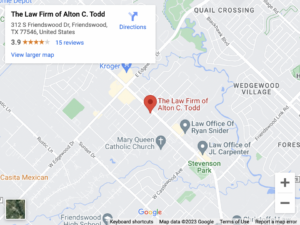
Please contact an experienced personal injury lawyer at The Law Firm of Alton C. Todd Personal Injury Lawyers to get a free initial consultation today. We have offices in Friendswood and Galveston, Texas:
The Law Firm of Alton C. Todd Personal Injury Lawyers – Galveston Office
2101 Mechanic St. Suite 253
Galveston, TX 77550
(409) 207-9299

The Law Firm of Alton C. Todd Personal Injury Lawyers – Friendswood Office
312 S. Friendswood Dr.
Friendswood, TX 77546
281-992-8633